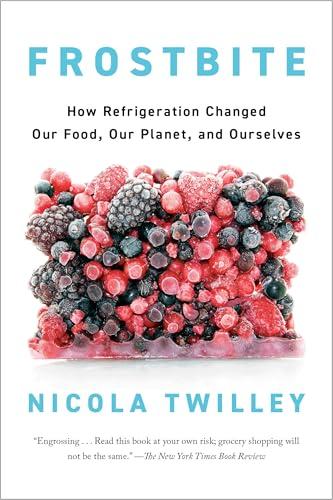
Frostbite: How Refrigeration Changed Our Food, Our Planet, and Ourselves
Product Type: Bargain Books
Price:
List price: $20.00
Available: 25+
Quantity:
copies bought in the last week
About
Winner of the James Beard Award for Literary Writing
Named one of the best books of the year by Smithsonian Magazine and New Scientist
An engaging exploration of refrigeration, tracing its evolution from scientific mystery to globe-spanning infrastructure, and an essential investigation into how it has remade our entire relationship with food.
A century ago, the introduction of artificial refrigeration overturned millennia of dietary history, launching a new chapter in human nutrition. We could now overcome not just rot, but seasonality and geography. Tomatoes in January? Avocados in Shanghai? All possible. In Frostbite, New Yorker contributor and cohost of the award-winning podcast Gastropod Nicola Twilley takes readers on a tour of the cold chain from farm to fridge, visiting off-the-beaten-path landmarks such as Missouri’s subterranean cheese caves, the banana-ripening rooms of New York City, and the vast refrigerated tanks that store the nation’s orange juice reserves. Today, nearly three-quarters of everything on the average American plate is processed, shipped, stored, and sold under refrigeration. It’s impossible to make sense of our food system without understanding the all-but-invisible network of thermal control that underpins it. Twilley’s eye-opening book is the first to reveal how refrigeration has changed what we eat, where it’s grown, how it tastes, and—most importantly—how it affects our health and the environment.
In the developed world, we’ve reaped the benefits of refrigeration for more than a century, but the costs are catching up with us. More important, refrigeration is one of the leading contributors to climate change. As the developing world races to build a US-style cold chain, Twilley asks: Can we reduce our dependence on refrigeration? Should we? A deeply researched and entertaining dive into the most important invention in the history of food and drink, Frostbite makes the case for a recalibration of our relationship with the fridge—and how our future might depend on it.
Named one of the best books of the year by Smithsonian Magazine and New Scientist
An engaging exploration of refrigeration, tracing its evolution from scientific mystery to globe-spanning infrastructure, and an essential investigation into how it has remade our entire relationship with food.
A century ago, the introduction of artificial refrigeration overturned millennia of dietary history, launching a new chapter in human nutrition. We could now overcome not just rot, but seasonality and geography. Tomatoes in January? Avocados in Shanghai? All possible. In Frostbite, New Yorker contributor and cohost of the award-winning podcast Gastropod Nicola Twilley takes readers on a tour of the cold chain from farm to fridge, visiting off-the-beaten-path landmarks such as Missouri’s subterranean cheese caves, the banana-ripening rooms of New York City, and the vast refrigerated tanks that store the nation’s orange juice reserves. Today, nearly three-quarters of everything on the average American plate is processed, shipped, stored, and sold under refrigeration. It’s impossible to make sense of our food system without understanding the all-but-invisible network of thermal control that underpins it. Twilley’s eye-opening book is the first to reveal how refrigeration has changed what we eat, where it’s grown, how it tastes, and—most importantly—how it affects our health and the environment.
In the developed world, we’ve reaped the benefits of refrigeration for more than a century, but the costs are catching up with us. More important, refrigeration is one of the leading contributors to climate change. As the developing world races to build a US-style cold chain, Twilley asks: Can we reduce our dependence on refrigeration? Should we? A deeply researched and entertaining dive into the most important invention in the history of food and drink, Frostbite makes the case for a recalibration of our relationship with the fridge—and how our future might depend on it.
"Engrossing . . . hard to put down." — The New York Times Book Review
Info
ISBN: 9780735223301
Published Date: June 24, 2025
Publisher: Penguin Books
Language: English
Page Count: 387
Size: 8.25" l x 5.63" w x 1.00" h